

THE GREEN BOATER BLOG
sustainable boating topics
Landmark UCL Study Confirms Electric Boats Are Dramatically Quieter — And It Matters More Than You Think
Scientific Proof: Peer-Reviewed Study Confirms Electric Motors as a Measurable Conservation Tool
UCL Study Proves Electric Boating is a Transformative Win for Marine Life
The Study
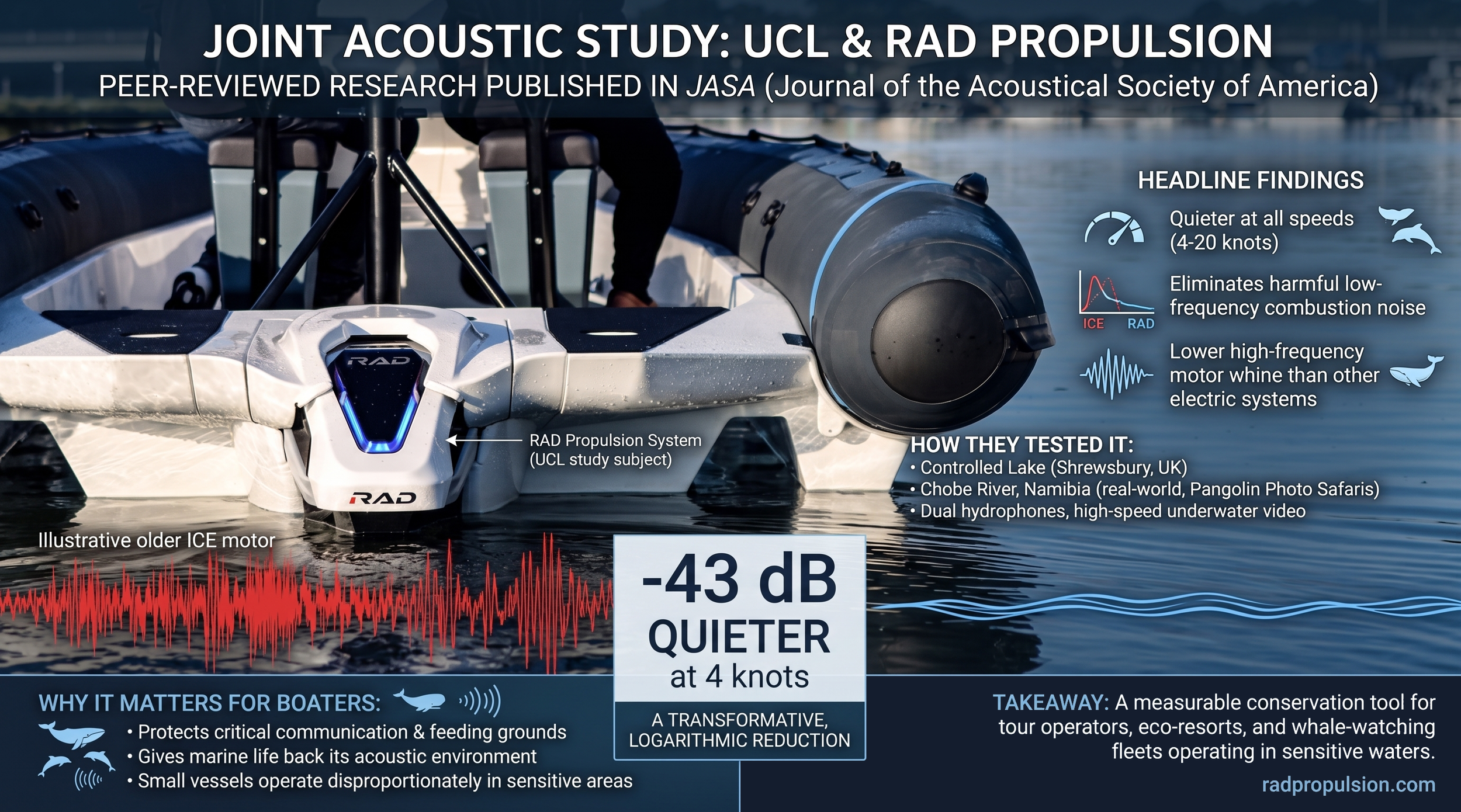
University College London's Department of Mechanical Engineering, in collaboration with UK-based RAD Propulsion, has published peer-reviewed research in the Journal of the Acoustical Society of America (JASA) comparing underwater radiated noise from electric versus internal combustion (ICE) outboard engines. It's one of the most rigorous comparisons of its kind to date.
How They Tested It
Two identical boats — one fitted with a RAD 40 electric outboard, one with an equivalent ICE outboard — were tested at speeds from 4 to 20 knots on a controlled lake near Shrewsbury, UK. Researchers used dual hydrophones, high-speed underwater video, and airborne noise measurements. They followed up with real-world testing in Namibia's Chobe River alongside Pangolin Photo Safaris' electric fleet.
The Headline Findings
43 dB quieter at 4 knots. That's a massive reduction — decibels are logarithmic, so this is a transformative drop, not a marginal one.
Quieter at every speed tested, even at 20 knots where propeller cavitation becomes the dominant noise source.
Eliminates low-frequency combustion noise — the kind that's especially harmful to baleen whales and other low-frequency hearing specialists.
Lower high-frequency motor whine than other electric systems previously studied, proving not all electric drives are acoustically equal. Engineering quality matters.
Why This Matters for Boaters
Underwater noise pollution is one of the most underappreciated environmental impacts of recreational boating. Marine mammals rely on sound for navigation, feeding, mating, and communication — and small vessels operate disproportionately in the sensitive coastal and inland waters where these species live. This study gives us hard, peer-reviewed evidence that switching to a well-engineered electric drive isn't just about cutting emissions; it's about giving marine life back its acoustic environment.
The Takeaway
For tour operators, eco-resorts, whale-watching fleets, and any boater operating in sensitive waters, this is the scientific validation the industry has been waiting for. Quieter boats aren't a "nice to have" — they're a measurable conservation tool.
Growing the Electric Wave: A Conversation with RAD Propulsion's CEO, Dan Hook
Watch Full Episode. Dan Hook: Future Proof Strategy for Marine EV

The Green Boater is thrilled to dive deeper into the exciting world of marine electric vehicles. We sat down with Dan Hook, CEO of RAD Propulsion, a UK-based company at the forefront of this technological revolution.
A Visionary Journey
Dan's passion for marine technology is deeply rooted. Having trained as a Naval Architect at the University of Southampton, he gained invaluable experience in small craft propulsion systems. This early exposure ignited a spark, leading him to co-found RAD Propulsion in 2018.
The company's mission is clear: to reduce carbon emissions and revolutionize the boating industry. By developing cutting-edge electric propulsion systems, RAD Propulsion is empowering boaters to enjoy a cleaner and quieter boating experience.

Navigating Challenges and Embracing Opportunities
While the journey has been marked by challenges, including the global pandemic, Dan's unwavering optimism and strategic approach have propelled RAD Propulsion forward. The company has successfully navigated the complex regulatory landscape and technical hurdles to develop innovative electric propulsion systems.
A Sustainable Future for Boating
RAD Propulsion is committed to building a sustainable future for boating. By focusing on energy efficiency, reducing emissions, and promoting responsible manufacturing practices, the company is setting a new standard for the industry.
Key areas of focus for RAD Propulsion:
Advanced Battery Technology: Investing in research and development to improve battery performance and range.
Innovative Charging Solutions: Exploring wireless charging and other efficient charging methods.
Sustainable Manufacturing: Adopting eco-friendly practices throughout the production process.
Industry Partnerships: Collaborating with key players in the marine industry to accelerate the adoption of electric propulsion.
A Call to Action for Boaters
If you're considering making the switch to electric boating, here are some tips:
Do Your Research: Explore the different types of electric boats available and their suitability for your specific needs.
Consult with Experts: Seek advice from experienced boaters and marine professionals to make informed decisions.
Consider Your Boating Style: Whether you're a weekend cruiser or a serious angler, there's an electric boat to fit your lifestyle.
Embrace the Future: Join the growing community of electric boat owners and contribute to a more sustainable future.
As the demand for cleaner and quieter boating solutions grows, electric boats are poised to become the norm. With companies like RAD Propulsion leading the charge, we can look forward to a future where boating is more accessible, sustainable, and enjoyable for everyone.