
THE GREEN BOATER BLOG
sustainable boating topics

Barnacide - The Solution For The Last Big Problem in Marine Coatings
We meet up with Dr. Reed Phillips, inventor of BARNACIDE® who shares his full story about the biofouling issues, current solutions and how their new solution is set to solve the problem - the first completely eco-friendly coating polymer coating.
It's a pleasure today to have a chat with the inventor of Barnacide, Dr. Reed Phillips, and we are going to have an opportunity to learn about Barnacide and also a little bit of a story for how Barnacide came to being. But most importantly, I want to just welcome Dr. Reed Phillips and this conversation that we have, which I think is going to be timely and very interesting for our Green Boating community. Welcome, Dr. Phillips.
Dr. Phillips
Hello, Bruno. It's a pleasure to be here with you today to talk about the research that I have been doing.
TGB
Wonderful. Well, listen, we appreciate the time and let's get right at it. So for the benefit of boaters who don't understand and even those new to boating and long term boaters, we all know that there's all kinds of issues in the ocean. And one of the biggest issues is the problem that boaters have, which is on the bottom of their boats. Tell us what the problem is that we are trying to address with products like Barnacide.
Dr. Phillips
OK, this this basic problem, which is still really unsolved as far as a really acceptable solution, is that when you submerge a boat in water, fresh water or marine water,(...) things like growing on the bottom, it could be algae, it can be barnacles, it could be other types of seaweed, it could be other something called shipworms or marine borers. And in freshwater, you have invasive muscles. They're similar to barnacles. They're called quagga mussels and tiger mussels.
And these things can be very, very destructive.
Dr. Phillips
Aside from damaging and obstructing and corroding piers and intake pipes and vents on stationary structures, with respect to boats,(...) when these organisms start coating a boat,(...) they greatly increase the friction between the boat and the running water adjacent to it, which is supposed to be a low friction, smooth process.(...) If you increase the friction considerably, that slows the boat down. You got to hit the throttle more. Your fuel consumption goes up as much as 40 percent.(...) And this is where I got interested in it because of that increased fuel consumption. Your greenhouse gas and carbon dioxide emission goes up too.(...) Biofouling, which is the name applied to all these organisms, is probably responsible for about the second or third cause of greenhouse gas emissions among industrial sources in the world. It's a real problem. It's contributing to climate change and so forth. So if one can prevent these plants and animals from growing on the surface of boats, small and large, up to the super tanker, you're going to basically clean up the atmosphere.(...) Now you'll also make a boater much happier because won't have that cosmetically awful gunk growing on the boat, which is unsightly.(...) And everybody wins.(...) Now how does this this biofouling develop?(...) Well as soon as you put a boat in water, within 24 hours, you got like a slimy layer growing on it. That's bacteria, fungi,(...) all sorts of one-cell organisms like that.(...) And then it's replaced by algae that start growing in larger quantities.(...) Within a week, you got a larvae from barnacles settling in on it.(...) And within three weeks to four weeks, you already have visible and fairly sizable barnacles growing on the surface. And once the barnacles are on the surface,(...) they adhere with a potency equal to mankind's greatest glues.(...) You can't just rub them off.(...) They make the surface unsightly, rough,(...) and the engine efficiency of your boat starts plummeting. That's it in a nutshell. The process, if left to itself, is complete within four weeks.(...) You start off with a brand new shiny boat, just leaving the factory in four weeks. You got this mess growing on your hull.
Dr. Phillips
So this is the major engineering problem that's still unsolved in the marine industry. How do you prevent this effectively without damaging the environment?(...) Those of us who have boats have seen this. We see it this, you know, every year that we do a haul out, we see it when we're walking by our boat and we look into the water, we can see the water line and all the things. We see the little biosystem that's under there.(...) And also in my boat, I notice maneuverability. It really slows me down there. Definitely it's what you mentioned, the friction is slowing down. So boating. There are millions. When you apply it to the propeller, when the stuff gets on the propeller,(...) then you have all sorts of vibratory problems in the propeller gets transmitted up your engine shaft and now you start to have physical damage to your engines.(...) Yes. And I've done some work with some of the folks in our local area who are working with marine biologists to reduce cavitation noise from propellers. So that's marine life can, you know, they're not, they're, you know, whales, dolphins, things like that. They can, you know, they're not bothered by the noise. So cavitation increases when you've got things growing on your prop. All right, let's switch to then the problem that exists. We've done that.(...) How is it solved? How is it solved today? There are millions of boats on the water. How are they doing it to solve this problem? Well, there are a couple of different schemes available.(...) Let me talk about the one that is predominant in the marine industry.(...) The procedure that they use, the mechanism they use is something called ablative anti-fouling paints.(...) What does that term mean?(...) Well, basically,(...) you put a biologically active chemical agent inside the paint matrix.(...) You place it on the boat.
And as the boat goes through the water,(...) the chemically active agent is leeches out from the paint into the water.(...) The chemical agent or agent, sometimes there are multiple, actually kills the algae and the immature barnacles that are trying to settle on the surface by poisoning them in the water adjacent to the hull.(...) Okay,(...) that fact is going to be very important to distinguish what we do because we do it totally differently.(...) Now, obviously, if something is poisoning organisms in the water near the hull, those chemicals are going to go everywhere.(...) And hence, it's environmentally toxic.(...) The type of chemicals that are usually used, the most common version, is something called heavy metals.(...) The original version was something called TBT, also known as tributyl tin, which came out in the mid-50s and was the most effective chemical known to prevent biofouling. It also turned out to be, by the 1980s, it was found to be the most toxic substance ever released into the ocean, and it was banned by the International Maritime
Organization in 2003. So it's against the law in more than 150 countries to use it. So the replacement for that was another heavy metal. Instead of tin,(...) they decided on copper. Why copper?(...) Because some people noticed when they went back to history that the British prevented biofouling to slow up their wooden ships by taking plates of copper and putting it on the deck,(...) on the hull, which prevented that. Copper was phased out of Britain because when they shifted over to steel boats,(...) you couldn't have copper on the bottom and a steel boat because you'd get a chemical reaction between the two. But copper did inhibit barnacles,(...) algae, and other things.
Mostly barnacles. It's not so good against algae. So when TBT was banned, they had to come up with replacement, and going back from history, they picked on copper.(...) So most of the paints that are ablative, and I'll define that term a little bit more in a moment because it's important to know what that term is precisely,(...) most of today's ablative anti-fouling paints have copper compounds of some form or another.(...) And the copper compound is released into the surrounding seawater, surrounding the hull, reacts with the seawater, and produces a compound that is lethal to barnacle larvae trying to settle on it.(...)
Now ablative paint come in two forms, and they're equally bad, but it's just a different set of problems.(...) One is called a hard ablative paint, where the paint stays on the boat,(...) but the biologically active chemical agent, which is usually copper, is released from the paint, and the paint gradually loses its reservoir of chemical agent,(...) and after one or two years has to be replaced with a new layer.
(...)
And typically that new layer is painted on the old now inert layer, and that can go on for about five years. You know, each year you put another layer on, after five years it gets so thick, you got to get it off the boat, okay, for good, because for various mechanical structural reasons, and you have a heavy scraping job, you have an environmental problem, what are you going to do with all the toxic stuff that you scrape off the boat, what are you going to do with it?
(...)
The other type of paint is soft ablative paint,(...) where not only does the chemical leach out to the water for its anti-biophiling effect, but the paint matrix, the paint itself, reacts with the seawater to dissolve and go into the ocean.(...) Now that has the advantage, of course, that the paint is always what they call self-polishing, the paint is always new with the layer of chemical agent on it, but obviously that is really toxic to the environment to have all that paint products just(...) dissolved into the ocean.(...) It's all sort of plastic breakdowns because the plastic, it's a polymer, what they call a technical term, an acrylic copolymer paint that breaks down in contact with seawater to release both the paint and the chemical agents into the seawater. So really in effect, Reid, we've got toxins, poisons that are leaching into the water from our hulls all the time and these toxins, they just don't disappear, they are attached already to organisms that are then introduced into the biosphere and consumed by other(...) organisms and now we've got these poisons going everywhere into perhaps even our food systems.
(...)
Fortunately, copper is not too toxic to us. It takes a lot for a human being to be copper toxic, but that's not, and so if it enters our food chain as the chief predator, apex predator they call it, it's no harm to us, but that's not true of plants and fish and other type of things like lobsters and and crabs and so forth. It's a real problem. Well, you know, the pictures sometimes I paint in my brain when I see, when I hear about this again and it's just as you're talking through this, it's just churning my stomach, but you might as well just go to your paint store, walk down to the marina at the end of the marina and just pour it into the ocean. I guess that's in effect what we're doing because I know on my boat every year I pull it out and I have soft ablative and when I pull it out there's big chunks of it missing and it has lost all its efficacy and it's gone.
TGB
So, you know, I've got what four gallons of this stuff on my boat. I mean literally I have this picture that I'm just pouring this paint into the water and if you were ever caught doing that in some states you'd be thrown in jail.
Dr. Phillips
That is the best analogy and I've been doing this for four and a half years. This is the best analogy anybody has ever said to me about this. Yes, we are literally pouring the paint into the water. I will use that from this point on. I promise to you. So, okay, now we've got the majority and there are millions of boats out there doing all this and it's not being addressed. So, as you said, it has a huge impact all over the place and I appreciate the time you took to do this.
Let's talk about what some of the systems are that people have tried to address this that perhaps because there's all kinds of new stuff coming out and I've interviewed folks on this channel as well.
TGB
So, how are some of the attempts being made to address this problem before we start talking about the way in which you've gone in solving this problem?
Dr. Phillips
Okay, sure.(...) Once you look for other solutions,(...) what people have come up includes several different items.(...) One thing that's getting a big play now is silicone-based systems.
(...)
Um,(...) silicone-based paints rely on the ability of extremely low surface friction,(...) the slippery feeling that these types of paints produce to prevent, uh, barnacles and other organisms from adhering to the surface. Sort of like the Teflon in our frying pans.(...) Precisely. Although there is a coating and, uh, it's actually one of our(...) mechanisms that actually is a Teflon, but we'll get to that point later. Um, it actually functions like a Teflon and as the boat moves, anything that did manage to attach to it generally gets shaken off.(...) But here's the problem with this. A boat that stays at mooring(...) for more than a week or two just simply allows the organisms to take all their time to get attached.
(...)
Now these organisms will go through anything. They don't care if it's steel, concrete, fiberglass of the boat. They're not choosy. They'll go through anything. So these silicone coatings don't work(...) on boats that are largely stationary,(...) boats that are very slow going like sailboats, for instance. Okay. Big problems.(...) Another method of dealing with biofouling was to produce electrical systems that would produce a very low voltage of electricity surrounding the boat, which would act unfavorable to the barnacles.(...) These systems never turned out to be reliable economic enough to work.(...) Is that the same read as the ones that produce a vibration? Is that same? Now there's another type of mechanism where instead of an electrical voltage, they'll use(...) what they call piezoelectric crystals,(...) sound wave transducers to produce a high frequency sound wave(...) in the vicinity of like 20 to 30,000 Hertz cycles per second, which is very unpleasant for the barnacles. They just haven't worked sufficiently well.(...) The Australian Navy had tried, because you know with large ships, you also have the problem on its internal plumbing as well as the hull, the inboard equipment and so forth. They tried chlorine gas to gas them, but the toxicity of that, that took care of that problem.(...) Then you get a variety of other tries,(...) biological(...) mimicries,(...) I'll call them. Shark skin.(...) Barnacles stick to whales and turtles under the water, but they don't stick to shark,(...) because shark skin has a certain structure that prevents them from doing it. So they have devised, and even there's some patents on it, to produce coatings that look like shark skin.(...) Prohibitively expensive.(...) I mean even compared to your most expensive paints which can go upwards to $500 to $1,000 a gallon.(...) Another thing was what you mentioned, the use of a protein to prevent it. Now proteins come in a wide variety, and I haven't told you my two careers yet, so I'll in a little while let you know what happened a little bit about this stuff.
They come in the form of plant toxins,(...) they come in the form of antibodies,(...) they come in the form of certain compounds that are in been seen in certain plants that birefouling doesn't grow on. You take large algae,(...) barnacles will attach to that too, but certain algae they don't attach.(...) Unfortunately with all of these biologicals, they're either too expensive because they got to be produced for very minute amounts, you know if you're extracting them from plants, or if you're chemically synthesizing them, it's just too expensive. So they haven't gotten much traction.
(...)
Then another idea was the antibacterial compounds that you spray on a sink surface to get rid of bacteria on your sink. Somebody got the brilliant idea of incorporating those chemical compounds in a coating.(...) Great idea.(...) They actually asked me for some advice on the subject.(...) When they did it, it simply didn't work.(...) So you can see that all of the various things going on here, while there's quite a variety, either it's too expensive or it doesn't work. There has been no replacement for the use of copper compounds.(...) In fact, jurisdictions that try to ban copper, such as California,(...) Washington,(...) the state of Washington, they've delayed putting those laws into effect because there's no replacement.(...)
There's a similar problem in the European common market, the European Union.(...) But the trend is that if you can replace copper,(...) everybody's going to get on the bandwagon to outlaw it.(...) So it's just a matter of time who does the job.(...) Well, there's all kinds of pressure. Certainly the environmental groups are creating pressure.(...) Our environment itself is telling us the ocean cannot absorb this any further. There's also an economic factor because the cost of fuel, I know for my, I have a diesel, a vintage diesel trawler, and the fuel prices are just astromonical now. And so efficiency, we're trying to get efficiency out of burning the fuel, but also trying to get efficiency out of actually moving my vessels through the water
TGB
And I know when I've come out of a haul out where all the running gear is smooth and the hull is smooth, I've got an extra one and a half knots on the trawler.
Dr. Phillips
You can actually feel that, is that true?
TGB
Oh, absolutely. Oh yeah, absolutely. And the Pacific Northwest here where I have my boat, we have these muscle fresh hits and you can actually almost see the muscle socks grow. It's crazy. Like from week to week.
Dr. Phillips
What do you have growing there? Muscles.
TGB
So muscles will grow in the form of, if you're in a marina where there's a current,(...) like a tide that's pulling current across your marina, the muscles will attach themselves in what looks like a sock, looks like a stocking where it'll start, it'll start in a localized area, usually around a through-hull because the blade of paint is already worn off. And then it'll actually form a sock that comes down and sideways because it's following the current. And these socks will grow, sometimes they'll grow two or three feet.(...) And by that time, they've... Because the water is really fresh water in that way. It is, it is. But as soon as, but it's full of organisms. Like if you want, if you go scuba diving into the Pacific Northwest, the plant life down there is fantastic. It's way better than Hawaii or any of the tropics, right? We don't have colorful fish. We've got colorful plants. And I appreciate what you said earlier about anything you stick in the water after a week, it's already got film, then it's algae, and then it's got all kinds of stuff. Well, there are certain times of the year here where it's called muscle freshet, where there's just a lot of muscle spores in the water and they will find anything to attach to. And if there's already algae growing on there, that's their little magnet.(...) And these things will just grow like crazy. And so, and they'll grow also more on the sun side of your hull. So if you're pointed east, west in your marina,(...) wherever the sun is shining, it will just grow like crazy along the water line. You get a crust of the stuff.
Dr. Phillips
Do these organisms, these muscles, do they form shells?
TGB
Oh, absolutely. Oh yeah. Okay.(...) And it's actually, if you're a person who loves to eat muscles,(...) all you have to do is take a muscle sock off and break it open and you'll never eat muscles again, because they absorb all of the effluent in the marina. And even though people say, "I never flush in a marina," that's not true. Because all you have to do is open up a muscle sock and crack these things. And these shells can be sometimes two, three inches long and they're massive. And they also are very damaging to your boat.
Dr. Phillips
You mentioned that they penetrate. Do you know if these are quagga muscles or tiger muscles or similar?
TGB
They can be. Yeah, they can be. But I can send you a picture of some of the stuff that's come off. I don't know. Any information you got on that.
Dr. Phillips
Well, I'm familiar with tiger and quagga in the Great Lakes and Lake Mead and so forth. What you're describing is interesting. Any information can send me. I appreciate it.
TGB
I had my boat in a, up a river, which was still tidal water. And so the water was very brackish. And that developed a whole different type of organism. I had my dinghy, left it in the water over the course of a year. And I pulled it out. This is my little hard bottom fiberglass dinghy. I had to almost, well, I had to take the gel coat off. This, the organism that grew on there, went right into, through the gel coat and started eating into the fiberglass. They attached itself to the fibers of the fiberglass. There's no way that you can just scrape that stuff off and slops. And you, I mean, it's just a horrible, horrible stuff. So, you know, it's surprising the power of nature.(...) My dad, who is now 91, built boats his entire life. And he said to me, he said, Bruno, nature eventually will win. Because it's so powerful.
Dr. Phillips
All the time. It's, it's, it's, it's dissolved every trace of prior civilizations.(...) Do you ever learn a new problem? It's a growing problem. It's an economic problem. It's a financial problem. It's an environmental problem.
(...)
Regulatory bodies want to, as you said, they want to impose restrictions because they care, but there hasn't been a solution today. Because boaters will flock there.
TGB
If I didn't have to take my boat out of the water for five years or four years, it saves on cost and pressure on my hull. It saves, and I can then, it saves on fuel. I can also ethically boat without knowingly poisoning the ocean. This is huge. It's a huge, huge problem with a, a, a market, if you will, that's just dying. So let's talk about your story.(...) I read a little bit on your website, so you actually didn't start in this area. You started somewhere else. Tell us a little bit about your, about your background, Reed.
Dr. Phillips
All right.(...) Now, basically, this is a very surprising to hear this, but my primary career is I'm a medical oncologist.(...) Okay. I treat cancer patients and I try to cure them. And that's what I've been doing most of my life.(...) I also have a second interest,(...) physics.(...) And when I was five years old, I got knocked over by a huge wave and I almost drowned.(...) And I thought that it's amazing how much energy is in the waves. So my rest of my life, every time I'm at the beach, I said, gee, couldn't we put to use some of this energy, make clean electricity?(...) I got the chance about 10 years ago when I slowed up a little bit on the medical oncology piece and I devoted half my time to go back to physics.(...) And I created some equipment that harvests the energy of ocean waves and converts it into clean emission free electricity.
(...)
Even got a dozen patents on it, you know.(...) And one day an engineer said to me, he said, Phillips, I really like your technology. It's really good stuff.(...) But I think you didn't take into consideration one little item.(...) And I said, oh, what's that?(...) He said,(...) barnacles.
(...)
I never owned a boat. So I looked at him funny. Barnacles? What I'm doing here, what does that have to do with that?(...) I said, you own a boat? He said, yeah. And then I got it real quickly. The barnacles start growing on the moving parts of a submerged electrical generator. In no time, the equipment will be destroyed.(...) So I knew I had to find a solution.(...) And at that time, I first investigated it.(...) And I saw that there was no credible solution available for this sort of thing. Okay. Especially on a piece of electrical generator operating on waves. You can't paint that every year. You don't like to do with a boat. So there was no solution. So I kept it in the wings. I kept quiet about it.(...) Moved the clock back four years later. I'm taking a vacation down the southwest with my wife and a few other couples. We were exploring the parks.(...) And we're in Lake Mead,(...) which of course has a quagga muscle problem.(...) But I knew nothing of this.
(...)
I go out to get some coffee. My wife wanted coffee. She didn't like the huge heat. So she stayed, walked to the hotel. I went outside because I wanted to see what was going on. And I saw this park ranger. And if this tale is too long, you can edit it. Oh, this is good stuff. No.(...) I saw this park ranger and he was setting up something that looked to be like a lecture in the field.(...) And he had this weird chair sitting there, you know?
(...)
It looked like a plastic chair. So I go over to look at it. And it's covered with what I thought was seashells. So I thought it was an antique chair covered with seashells. And I'm starting to touch it and see what's going on. Why would anybody want to do something like that? It's not an antique, you know?
(...)
So a guy, the forest ranger comes over to me. Please, sir, don't touch that. It took two years to produce.(...) I said, this is a PVC chair with seashells on it. Somebody's trying to make an antique chair out of it. So, oh, no, no, no, no, no, no. We put this chair in Lake Mead two years ago. And this is what grew on it.(...) And I'm giving here a lecture to show a bunch of college students
(...)
what is happening.(...) So I said to myself, oh, boy, I hit pot, you know, right away the memories came back. I hit pot luck. I said, can I sit on this one?(...) She said, oh, sure, sure, sure. Can I ask some questions as you give the lecture? So 50 college students pile in.(...) And I'm in the audience in the back.(...) And he starts giving the election. They were all looking, checking their emails, checking their laptops. No one's paying attention. But as he's talking, I'm raising my hand asking questions. This, that, this, the other thing. After a while, everybody put away their equipment. They're listening. Okay. While this guy was talking,(...) I said to myself, hey, I can solve that problem.(...) It's not too much different than eliminating cancer cells versus eliminating barnacles. Well, at that time, muscles, because it was muscles. I wasn't directing myself at the barnacles.(...) There's not that much difference in eliminating cancer cells versus eliminating quagga muscles and later to find out tiger muscles as well. Okay. I can do that. You just have to use the principles of chemotherapy to do that. But you have to do it in an environmentally safe way.
(...)
Not like putting toxic stuff into the body to kill cancer. So I knew I could solve the problem. Okay. But who's going to work on that unless you get some kick in the rear end? It so happens one of my friends, when I explained the story to him about two weeks, two weeks later, came over to me and said, look,(...) I'm interested in having you start a company with me to try to come up with a coating that can be environmentally friendly using the principles that you use in human oncology to eliminate barnacles, seaweed, shipworms, and everything else that can grow on there, including some of those other interesting organisms, which you'll give me information on.
(...)
And I said, okay, if you think I can do it, I think I have the knowledge to do it. Let's go do it. And that's how the company, Redjack, which is our company, was formed.(...) And I did my testing.(...) Many, you know, I tried different combinations, of course, on the available possibilities that could be used.(...) A local marina was very nice, gave me one of his docs said, I'm going to charge you for it. You can use it for your testing.(...) And the coatings worked.(...)
TGB
So let's, can I just roll the story back just a little bit? And can you help me connect the dots, the dots here between cancer treatment and why it would solve the problem with fouling, biofouling in layman's terms? How did, how did that, how can we make that connection?
Dr. Phillips
Okay. The way you, the way you eliminate a cancer cell from the body is to introduce a compound.(...) Any compound could be chemotherapy, could be immune therapy, could be anything, a compound that gets into the cell and interferes with the function of one or more parts of the cell.(...) If that happens, the cell dies.(...) However, human cancer cells are extremely good(...) in developing immunity. If you use one medication, it'll find a workaround in the same way that if you are in a car and you have a detour that's not letting you go down this road, you will learn how to get home anyway by taking a detour. Cancer cell does the same way.(...) So the principles of chemotherapy and cancer therapy are that you use multiple drugs and you attack the cell by multiple different mechanisms.(...) And by that means the cell isn't able to get immune that easily and you have a much better success rate.(...) Okay. So you employ the same principle dealing with barnacles and muscles.(...) Barnacles and muscles are, it's a varied population. It's a varied population.(...) If you use a single drug or chemically active substance, some will be resistant, some will be sensitive to it, some will find a workaround the problem.
(...)
So you use multiple different agents,(...) multiple different chemicals to make the environment so unpleasant for the biofouling that it just can't get started. Okay. Okay. That's a great, great connect the dots story. I understood that. Let's talk about barnicide. So you mentioned your company. Now you started a number of tests to see if you can make a viable product. So help us understand the basics of barnicide. And then we'll talk about its ability to solve the problem and then how we apply it and where we can get it. So first about Barnacide, tell us a little bit about the product itself.(...) Okay.(...) Barnacide is an anti-fouling coating system.(...) It's not about a particular type of chemical.(...) It's not about a particular type of polymer paint.
(...)
It's a system that can use a multitude of different possible agents and can use a multitude of different possible polymers for the paint matrix. You can mix them up in any order you want as long as it accomplishes three goals.
(...)
It's environmentally safe.(...) It's effective.(...) And the coating system will last several years. These are the three objectives.(...) Okay.(...) And we settled on a set of a set of biologically(...) active chemical agents that satisfied this situation.(...) But it's not just a chemical coating system consisting of one layer.(...) There's two layers to it.(...) And both coatings are different because they're functioning in different manners. What we attempt to do with our coating system is to make the surface so unpleasant for(...) the barnacle and other organisms to settle on that they want to go someplace else.
(...)
Our coating system is not designed as a pesticide.(...) It's not designed to kill, eliminate animals.(...) It's designed to protect the surface by making them go elsewhere.(...) So how do we do this? Well, like I said, we use a two layer system.(...) The first layer has one or more biologically active chemical agents that when present in the in the coating,(...) when the barnacle larvae, which are little organisms like tiny tadpoles, if you want to call them, when they try to settle on the surface,(...) they feel, if you want to put it in human terms,(...) they feel like a sting, an unpleasantness.(...) They don't like it.(...) So instead of settling in and starting to grow, they lift themselves off and they go someplace else, providing the protection to the coating and the ship hull underneath it.(...) Now, like human beings are genetically different. If you give a thousand people the COVID vaccine,(...) 900 of them will be quite protected by the COVID vaccine. But because of genetic differences between people or hundred people won't have any effect from the COVID vaccine.(...) Well, the same thing occurs with barnacles.(...) The first coating layer will repel almost all the barnacles coming at it, but a few because of their internal makeup and their genes won't be bothered by the first coating.(...) So under the first coating, we have a second coating with a different set of one or more biological age, chemically active agents.
(...)
And if the tiny immature barnacle gets through the first layer,(...) and when it gets through the first layer, it's still tiny, only maybe a tenth of a millimeter in size. So you can barely see it. If it gets to the second layer and touches that second layer, it comes in contact with it, and that second layer eliminates the barnacle, the juvenile barnacle, as we like to call it.(...) It can't settle there and eventually falls off.
(...)
The hole is so tiny that because of the pliability of the coating, the pliability of the coating tends to just seal off the area. And so between the mechanisms operating on the first layer and the mechanisms operating on the second layer, not much hangs around.(...) Again, see the analogy with the cancer chemotherapy, multiple mechanisms affecting the organism.(...) So how happy are you with this product and the performance? Did you achieve what you wanted to achieve?(...) Yes, as a matter of fact, yes. I could even send you some pictures if you'd like.(...) If I knew that, maybe I could have even had the pictures and display it. We'll put that into post.(...) I can send that to you.(...) Panels that were not painted with it were covered with the biofouling like you'd expect.(...) Panels that were not covered with it,(...) excuse me, panels that were covered with it were squeaky clean.(...) Now,(...) you know, you got to do some maintenance on the coating. I mean to maintain that squeaky clean look.
(...)
What I used to do with my panels, and my panels were put into the worst possible area, a stagnant water in a marina.(...) This panel's never moved.(...) So every two weeks I would,(...) using just a dry paper cloth wipe, just wipe the surface off, just to get rid of some of the biofilm that could accumulate.
(...)
And the panels remained squeaky clean.(...) Now, as a test, I also ran what would happen if you didn't bother to do any maintenance on the boat. And the boat just sat there for a long time. Well, at the end of two and a half years, I let this test run.(...) Okay.(...) The boat surface didn't look cosmetically great.(...) There were a few algae in there.(...) It wasn't lustrous anymore, the coating. It wasn't cosmetically exciting, but no barnacles.
TGB
Fantastic. No barnacles.
Dr. Phillips
Yeah. So, I mean, to use our coating properly, it doesn't mean, "Oh, I don't have to have any more maintenance on my boat. I could just let it sit there and never touch it," and so forth. You still have to treat your boat as an important instrument and treat it nicely because you want it to be cosmetically beautiful, as well as free as barnacles.(...)
TGB
So, how have you addressed the environmental side of it? So, I understand the principle of how it works, but when you talk about in the second layer, a barnacle going in or a muscle going in and penetrating, then it doesn't like it and falls off. Is it taking any kind of toxins with it? Anything that could harm the environment?
Dr. Phillips
No. And here's the reason why.(...) Generally, the biologically active chemical agent in the inner coating is much more powerful than the outer one.
(...)
And it can even, if we wanted to, doesn't have to, but it can contain containing compounds also.(...) But you see, that layer never gets in contact with the environment because it's covered by the outer layer, which has chemicals that are environmentally safe. So, it's also protecting the under layer. It's protected. Exactly. And as I said, the tiny little hole that gets made, because one person did ask me, "Well, didn't that one, that little tiny hole, couldn't that cause some seepage?" Well,(...) I said, disregarding the fact that this hole is 0.1 millimeter in diameter, if it shed anything, you got to compare that with the entire hull of a boat that's shedding it.(...) But I said, like I say, the hole tends to seal itself up because of the surrounding polymer, just the pressure of it. It's pliable. It just seals itself up. So, that inner layer is completely separated from the outer water. Okay? Yes.(...) Now, so what's going on on the outer layer, though, that makes it environmentally safe?(...) The biologically active agents that are picked are picked in such a way that they're insoluble in water.(...) They are locked up into the lattice structure of the polymer. They're locked into the paint.(...) The agents don't go into the water to eliminate the barnacle, like the... The ablatives. Anti-fouling ablative paint still. Okay?(...) The barnacle larva land on the coating,(...) the feet of the lar... What's called feet? It's not the technical term, but they have feet,(...) you know, to our comprehension. When they touch this coating,(...) the receptors in the feet of the barnacle larva feel things they don't want to feel, and that causes them to butt out and leave.(...) Nothing goes into the water.(...) Because of this structure and the use of certain polymers that last multiple years, we believe we can get five to ten years worth of action out of it, which of course cuts down the environmental toxic.
Toxicity of scraping off the paint and eliminating all those paint residue waste products and shipping them off to the toxic dumps,(...) landfills.(...) So as a result, the ocean does not pick up any environmental toxicity at all.
TGB
Can we talk about how the product is applied? So let's go through a day in the life. So a boat like mine, mine's wood, happens to be wood, but there's most of the boats out there are fiberglass, so let's talk about that. So if I had a fiberglass boat and I had a traditional anti-fouling coating,(...) what were the steps would be to, first of all, prepare my boat for Barnacide and then how do I apply Barnacide?(...)
Dr. Phillips
Okay, well, whether or not using Barnacide or an anti-fouling, a blade of paint, you don't just apply it directly to the fiberglass.
(...)
It's generally recommended you use a primer first, usually an epoxy primer. You put a layer or two of that on and then you put your anti-fouling coating on.(...) Now, if it's an ablative coating,
(...)
I think a lot of people recommend two coats,(...) even of two different colors.(...) So if you see the outside coat giving out before it starts working on the fiberglass and gel coat of the hull, you see that the inner layer is coming through in a different color and that's telling you it's time to repaint.
(...)
In the case of the arc coating,(...) the inner coating is such that it could actually be a primer itself. So you can put that on first.(...) Right on top of the epoxy layer or directly on the fiberglass? You can do either one. Okay. You can do either one. But you'd have to remove, if there is already a blade of paint on there, you'd need to remove that obviously first.(...) Not totally, not totally. There can't be any loose flakes.(...) It should be sanded down well,(...) like you would if you were to apply another coating of ablative paint. You can't have any loose areas, all the solvents, residue,(...) sand, everything. You want a strong mechanical bond. You want a strong mechanical bond. That's true of both systems.(...) I personally,(...) look, ours is a new product. Okay.(...) It's still undergoing some testing. I would probably be personally conservative and recommend that it be put over a standard epoxy primer. Okay. As a recommendation initially.(...) Okay. I don't believe it'll turn out to be necessary.(...) Where it is necessary though,(...) is if you're using an aluminum or steel hull,(...) you don't want a situation where let's say if copper was used on the inner epoxy coating,(...) you don't want it to come in contact with aluminum or steel hulls because you can get a galvanic or otherwise known as electrical reaction, chemical reaction between the two metals. And that is not good. That is not good. There are also a certain copper compounds that you use in the inner layer that do not react with aluminum or steel and you can get around that problem. Seahawk makes use of a compound that you can put directly on aluminum. Okay. So the surface of the boat is prepared properly, nice and clean,(...) making sure you can get a good mechanical bond. There's no chemical agent so how then is is barnicide applied?(...) Each layer is a two component part A, part B system.
(...)
You mix it together in appropriate amounts and then it can be applied by brush, roll or air spray. The application of it itself, other than mixing a two component
(...)
mixture together, is the same as any other paint product you would apply.(...) Obviously
(...)
ablative anti-fouling paints that are one component,(...) you just don't have to mix a part A, part B. It's a little simpler.(...) On the other hand ablative you got to paint more than one coat of each for the reasons that I specified because it's ablative.(...)
In our case, since it's not ablative, you just have to do those two coats, the inner coating with its biological agents and the outer coating with its biological agents. So it's something that for a do-it-yourself boater who's used to mixing epoxies or mixing two-part paints, standard stuff, this isn't something that you would need special training for. It's standard kind of thing.(...) We do need to take proper precautions. You don't handle this without gloves. You should wear a mask when you're doing it. If you're indoors in a garage, let's say painting a boat,(...) you can't be sloppy with it because poxy by definition, if you want to talk about the inner layer, by definition is toxic if you're not careful with. In terms of its application, so how much time to dry, how much time between layers, it's important because when you're paying to have your boat hauled out, you're paying for all the time that's on the hard.(...) How much time would it take between layers of drying and reapplying and then curing?(...) If you wanted to put more than one layer on for various reasons, you can do that within four to six hours of the original layer.(...) When you're talking about putting down the inner layer first and then the outer layer next,(...) eight to 24 hours separating.(...) If you wait longer,(...) you can wait longer, you can wait a week, but then it might be advisable to get, because you want the proper, not only chemical adhesion, but mechanical adhesion. You might want to do a very light sandpapering of the surface if there's an extraordinary amount of time, between layers.(...)
TGB
Okay, and so where are you with the ability, you mentioned testing, so where are you in the life cycle of the product right now? When will it, in your estimation, will be ready for the marketplace?(...)
Dr. Phillips
Okay,(...) we are estimating the commercial availability of it within six to 12 months.(...) We are doing, we're hoping to do a complete final testing on it within the next six months allowing for some slippage of scale, which sometimes happens because it vents out of your control. It could be as long as 12 months, but it could be six months we're aiming for, 12 months we ought to definitely do it.
TGB
Yeah, wonderful.(...) And does it come in any color except black, like Mr. Ford said?(...)
Dr. Phillips
Yeah, you know, that's interesting.(...) You know, it originally came in white,(...) okay, and the first person that was going to test it said, "Oh, I can't put that on my boat because it's got to be blue." Okay, and we learned a little bit about marketing on that one. Okay, actually we have the capability of making it in any reasonable color by adding the necessary pigment.(...) I have been joined in addition to my business friend and myself,(...) I did tell you about our third specialist that joined us, an organic biochemist, excuse me, an organic chemist, PhD organic chemist with a 30-year history of coatings experience with major paint companies whose specialty is bringing prototype products like I made into the commercial sphere.(...) So he said, "Look, at first we're going to probably come out with one color. We can't cater everybody, you know, on day one, but in short order we should be able to supply any reasonable color, white included."(...) Sure, sure, wonderful. Well, you know, this is really encouraging because the science that you've explained, I understand, and it makes sense. I certainly understand the problem as a boater and anybody who has a boat, especially in areas where there is fast-growing algae, mussels, barnacles. I mean, if there's one thing that's the bane of boating, it's this, it's the underbelly. And it's also the biggest problem, you know, people talk about, "Oh, let's avoid single-use plastics." Okay, that's a big problem. This is way bigger.
TGB
How do we follow the progress of your company and the product?
Dr. Phillips
We do have a blog capability on our website, which you've been to at barnicide.com. We do have a blog capability, which we're going to use to post such information.
TGB
So this will be on our podcast and we'll put it out. Dr. Phillips, I so appreciate the time that you've taken to just walk step by step. And it's fascinating. And we are all pulling for you.(...) I am looking forward to one day walking into a chandelary and seeing the product there. And I will happily buy it and put it on my boat and shout it from the mountaintops because this is a serious problem.
Dr. Phillips, thank you for your time. I look forward again, as I said, to more things coming in the development of the product as it becomes a commercial product.
Dr. Phillips
All right, Bruno, pleasure being here.

Eco-Friendly Coffee Makers on a Boat
As a boater, you probably already know that many of the things we use on boats are not environmentally friendly. However, that doesn't mean we can't make small changes to reduce our carbon footprint. One way to do this is by using eco-friendly coffee makers on board. In this blog post, we will discuss the benefits of using such coffee makers, and present some of the best eco-friendly coffee makers available on the market.
Introduction
As a boater, you probably already know that many of the things we use on boats are not environmentally friendly. However, that doesn't mean we can't make small changes to reduce our carbon footprint. One way to do this is by using eco-friendly coffee makers on board. In this blog post, we will discuss the benefits of using such coffee makers, and present some of the best eco-friendly coffee makers available on the market.
Benefits of using eco-friendly coffee makers
Eco-friendly coffee makers are designed to consume less energy and produce less waste. They are also made with materials that are biodegradable, recyclable, or made from renewable resources. By using an eco-friendly coffee maker, you help reduce your carbon footprint and contribute to a cleaner environment.
Another benefit of eco-friendly coffee makers is that they are often more durable and require less maintenance than traditional coffee makers. Many of them also have a sleek, modern design that looks great on any boat.
Best eco-friendly coffee makers for boats
AeroPress Coffee and Espresso Maker - This compact and durable coffee maker is made with BPA-free materials and requires no electricity. You can use it to make both coffee and espresso, and it comes with a reusable metal filter that eliminates the need for paper filters.
French Press Coffee Maker - French press coffee makers are a classic choice for boaters. They are simple, require no electricity, and are made with glass or stainless steel. They are also easy to clean and produce a delicious, full-bodied coffee.
Wacaco Minipresso is an eco-friendly coffee maker that is perfect for boaters. It is compact, lightweight, and requires no electricity, making it easy to use on board. The Minipresso uses a manual pump to create pressure and extract coffee, eliminating the need for electricity or disposable pods. Additionally, it is made with durable and recyclable materials, making it a sustainable choice for environmentally conscious boaters.
The Moka pot is easy to use and produces a strong, flavorful coffee that can rival that of expensive coffee shops. Its compact size makes it easy to store on a boat, saving valuable space that can be used for other necessities. Additionally, the Moka pot is easy to clean and maintain, making it a convenient choice for boaters who may not have access to a lot of cleaning supplies.
A phin (or phin filter) is a Vietnamese coffee filter that is typically made of stainless steel and consists of a small cup with tiny holes, a screw-on lid, and a filter chamber. It is used to make Vietnamese-style coffee, which is a strong and flavorful coffee that is often served with sweetened condensed milk. The phin filter is known for its simplicity and portability, which makes it a popular choice for travelers and outdoor enthusiasts. It is another option for making coffee in an eco-friendly way on a boat.
A briki is a traditional Greek coffee maker that uses a simple design to make a strong and flavorful coffee. It is made of copper or stainless steel and consists of a small pot with a long handle and a spout. To make coffee with a briki, you simply add coffee grounds and water to the pot, and then heat it over a stove or flame. As the coffee boils, it creates a thick and creamy foam that is unique to Greek coffee. While a briki is not specifically designed for boating, it could be a good option for boaters who want to make coffee in a traditional way.
Conclusion
Using eco-friendly coffee makers on a boat is a great way to reduce your carbon footprint and contribute to a cleaner environment. By choosing coffee makers made with sustainable materials and designed to use less energy, you help protect the oceans and marine life that make boating so enjoyable. We hope this blog post has given you some ideas for eco-friendly coffee makers to try on your next boating trip. Happy sailing!

AIRHEAD COMPOSTING TOILET CAN SOLVE 4 PROBLEMS ON YOUR BOAT. ODOR. COST. WATER. POLLUTION.
Learn how the Airhead Composting Toilet can solve 4 problems on your boat. The Green Boater speaks to Zack with Airhead Toilets at the Seattle Boat Show.
Understand how a marine composting toilet works compared to traditional marine heads like Vacuflush. We find out the how the different components fit together, how simple the toilet is to install and how little it costs to run. We heard crickets when asking about the maintenance costs!
Learn how the Airhead Composting Toilet can solve 4 problems on your boat. The Green Boater speaks to Zack with Airhead Toilets at the Seattle Boat Show.
Understand how a marine composting toilet works compared to traditional marine heads like Vacuflush. We find out the how the different components fit together, how simple the toilet is to install and how little it costs to run. We heard crickets when asking about the maintenance costs!
Four key reasons why a boater, concerned about reducing ocean pollution, should consider installing a marine composting toilet:
No boat odor
No maintenance costs
No water consumption
No ocean pollution
The benefits are clear.
Watch the full interview below.
For more information about the Airhead Composting Toilet visit the company website at https://airheadtoilet.com/
About Airhead Toilet - Eos Design LLC
Airhead pioneered the use of diversion technology for small living spaces in 2001. “Air Head” is the first fully self-contained diversion composting system ever developed. Since that time its legacy is thousands of installations in at least five continents. Early the company focused on the most demanding application: marine. More recently its units can be found in anything from off the grid housing to RV’s. Their vision has become the choice problem solver for many people who want to live with less environmental impact in tiny houses. The company has years of experience and commitment that sets them beyond other companies who have chosen to mimic their technology.
Location Eos Design
LLC 775 Main St,
#481, Westbrook,
ME 04098
About The Green Boater (TGB)
TGB seeks to educate boaters about innovative products and proven practices that can help stop all forms of ocean pollution. WE CONNECT WITH MANUFACTURERS, EXPERTS, INFLUENCERS, ENVIRONMENTALISTS AND SCIENTISTS TO EMPOWER BOATERS WITH KNOWLEDGE TO HELP STOP ALL FORMS OF OCEAN POLLUTION.
Our goal is to empower one million boaters to change one thing which helps reduce ocean pollution. The one million boater pledge can be found on the company website here: https://www.thegreenboater.com/1-million-actions
One Million Boater Pledge
Will you join ONE MILLION BOATERS who are willing to CHANGE ONE THING which helps reduce OCEAN POLLUTION?
Watch full videos at The Green Boater TV

HOW DID A SEA URCHIN INSPIRE A NEW ECOFRIENDLY ANTIFOULING COATING FOR BOATS?
The Green Boater meets up with Dr. Rick Breur, founder of Finsulate, a European company who has created a new and revolutionary antifouling coating for boats - inspired by nature: the lowly sea urchin! Traditional antifouling coatings are considered harmful to the marine environment since they contain biocides and toxins which ablate off the hull surface and enter the marine eco system.
Ocean Friendly Coating Inspired by Nature
The Green Boater meets up with Dr. Rick Breur, founder of Finsulate, a European company who has created a new and revolutionary antifouling coating for boats - inspired by nature: the lowly sea urchin! Traditional antifouling coatings are considered harmful to the marine environment since they contain biocides and toxins which ablate off the hull surface and enter the marine eco system.
Finsulate is applied by first cleaning and preparing the boat's hull surface. Then, the adhesive film is cut to fit the shape of the hull and applied to the surface using a special applicator tool. The film is then compressed onto the surface to ensure a tight seal. The process is relatively simple and can be done by a professional or by the boat owner themselves. Finsulate Antifouling coating is a specialized coating designed to prevent fouling on the hull of boats and other marine vessels.
Fouling is the accumulation of marine organisms such as barnacles, algae, and other marine growth on the underwater surfaces of boats, which can decrease the vessel's speed and maneuverability and increase fuel consumption. Finsulate Antifouling coating works by creating a protective barrier on the hull of the boat that inhibits the attachment and growth of marine organisms. The coating is made of a specially formulated, environmentally friendly adhesive film that is applied to the hull of the boat.
One of the benefits of Finsulate Antifouling coating is that it is easy to apply and can be installed quickly without requiring specialized equipment or expertise. It is also a long-lasting solution, with a lifespan of up to three years before needing to be reapplied. Finsulate Antifouling coating is also environmentally friendly, as it does not contain any toxic chemicals that can harm marine life or the environment.
Overall, Finsulate Antifouling coating is an effective and sustainable solution for preventing fouling on boats and other marine vessels. About Finsulate Finsulate is a typical Dutch maritime invention and has been applied to yachts and vessels on every continent. Ranging from small sloops and day sailors up to offshore support vessels and dry weight bulkers.
The Finsulate concept works in any environment and is up to any challenge!
Finsulate Websites:
https://www.finsulate.com/en/
https://www.finsulateusa.com/
Take the One Million Boater Pledge.
We are looking for one million boaters who are willing to change one thing in their boating practices which will help reduce ocean pollution.
Read more here: https://www.thegreenboater.com/1-million-actions

Mercury Marine Enters the ePropulsion Market with the Avator 7.5 Electric Outboard
Mercury Marine Reveals New Electric Outboard Motor - The Avator 7.5e
The Avator 7.5e is an exciting new addition to the Mercury product line, offering a glimpse into the future of boating technology. With its advanced electric motor and lithium-ion battery, the Avator 7.5e represents a major step forward in eco-friendly boating.
As the world moves towards more sustainable practices in all aspects of life, boating is no exception. Traditional gas-powered outboards can be noisy, polluting, and expensive to maintain. The Avator 7.5e offers a reliable and efficient alternative that reduces both your carbon footprint and your operating costs.
The Avator 7.5e is designed to provide boaters with a reliable and efficient alternative to traditional gas-powered outboards. Its powerful brushless motor delivers impressive speed and performance, while its lithium-ion battery provides long-lasting power that can be recharged quickly and easily. This means you can spend less time worrying about fuel and more time enjoying the water.
In addition to its impressive performance, the Avator 7.5e is also designed with user convenience in mind. Its digital display provides real-time information on battery life, speed, and other important metrics, while its simple tiller handle makes it easy to control. The built-in GPS system also makes navigation a breeze, allowing you to focus on enjoying your time on the water.
Furthermore, the Avator 7.5e is a quiet and low-maintenance option that will minimize the disturbance of marine life and maximize your time on the water. Additionally, its eco-friendly design means you can navigate through environmentally sensitive areas without leaving a negative impact.
Overall, the Avator 7.5e is a game-changing electric motor that offers a glimpse into the future of boating technology. As more boaters seek out eco-friendly alternatives, the Avator 7.5e is sure to become a popular choice among boaters of all levels of experience. Invest in the future of boating technology with the Mercury Avator 7.5e Outboard.
=================
Watch Full Interview on The Green Boater TV
https://youtu.be/6VA3fpX78Mc

What is a Green Boater?
What is a Green Boater?
A Green Boater is a term used to describe boaters who are environmentally conscious and take steps to reduce their impact on the marine environment. They choose to use eco-friendly products such as biodegradable oils and lubricants, biocide-free antifouling paints, and low-emission engines, and also take steps to reduce their energy consumption and waste production while on board. They are also aware of the effects of their boating activities on the marine environment and take actions to minimize their impact, such as avoiding sensitive habitats, adhering to speed limits, and properly disposing of waste.
Green Boaters may take steps to minimize their impact on the surrounding area, for example, by avoiding anchoring in sensitive areas, or using eco-friendly cleaning products while underway or at anchor.
Being a Green Boater is not only good for the environment but also for the boater's own health and well-being. It is a great way to raise awareness and educate others about the importance of protecting the marine environment.
Propeller Coating Performs for Two + Years
Propeller Coating Shows 2 Years of Protection
Rarely do we rave about a specific product on the market. But as we prepare for the upcoming boating season, boat owners will be hauling out and working on their hulls and running gear. The dreaded bottom painting and coating.
My 48.5 wooden trawler sits in marine life rich ocean water for 51.5 weeks of the year. Most of the time not moving - either at anchor or tied up in her home berth marina. A perfect environment for barnacle and organic growth.
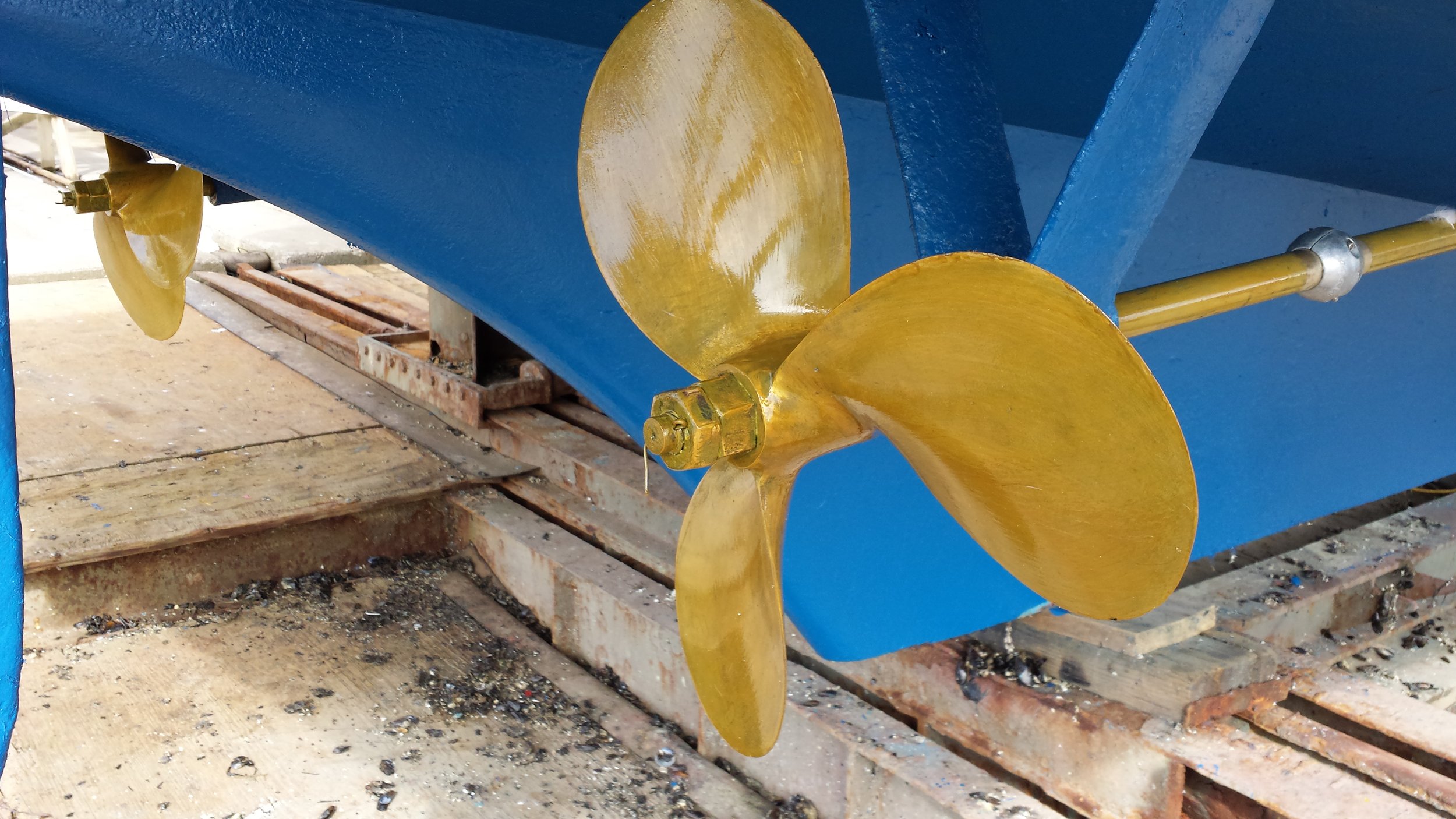
One year I had a boatyard coat my twin props with Propspeed. A two part treatment that looked stunning in yellow once applied. The immediate effect was speed. My hull speed increased at least .5 knots. Partly because the hull was clean but also because of the slippery surface on the Propspeed product.
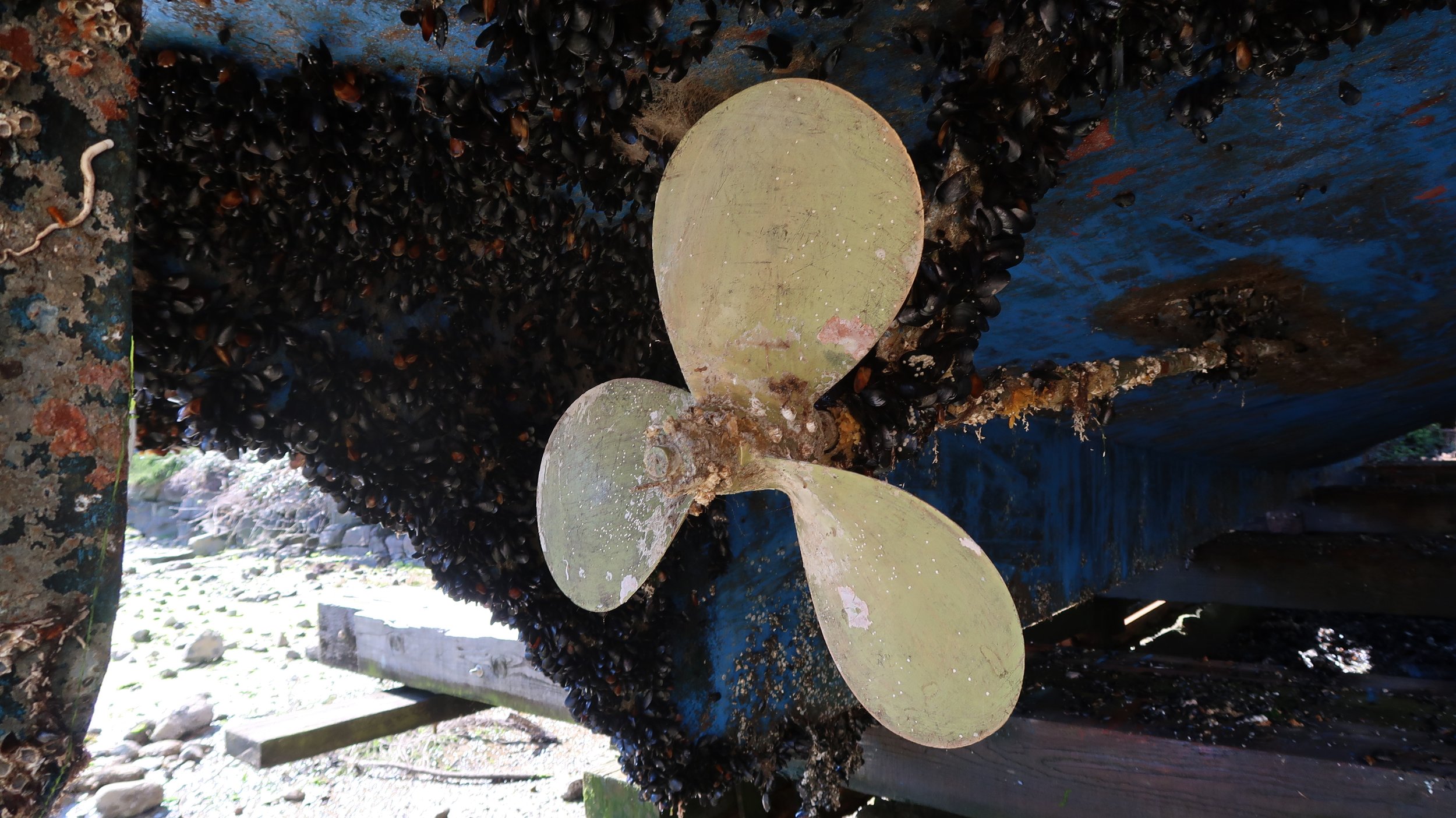
That next year I moved my boat moorage from the USA to Canada and messed up my annual haulout routine. So after two years in the water, I pulled out my boat and to no surprise my hull was covered in mussel and barnacle growth. 40 burlap sacks of material was removed! BUT. My props which were treated with Propspeed looked, well, like they could go at least another year or two. Apart from some growth around the prop nut, these babies looked dang clean.
Now if I could only find a bottom paint that was eco friendly and could last 2+ years, I could revise my haulout schedule from an annual routine to at least 2 years or more!
Here are my before and after pictures of the props treated with Propspeed and then 2 years later…
Tesla Quality Electric Propulsion Arrives in the Consumer Boating Market
Not long ago heads would turn when a sleek new Tesla drove past. Now they are commonplace. And most of the other ‘traditional’ manufacturers are offering electric powered models as well. So the tipping point* for electric powered automotive vehicles is rapidly approaching if not already here.
The recreational boating market appears to be poised to begin a similar journey. Simply google electric power boating terms and you will discover new entries every day, across all marine sectors, from startups to mainstream, and from manufacturers around the world.
In 2019 this writer visited the Seattle Boat Show to find eco-friendly products for boaters. One of the themes for this edition of the show was Electric Power. One of the vendors, Pure Watercraft, was showcasing their latest prototype - a 40 HP electric drive leg - bolted onto a 90 year old wooden sea sled. It was magnificent to see the old classic with a sparkling new low profile drive leg. Naturally this caught my eye - and the interest of a future partner - General Motors.

Pure WaterCraft Partners with GM
In 2022 GM acquired a 25% stake in the Seattle based company - Pure Watercraft. The 2019 prototype has since been refined into a commercial product and now offered for sale as a stand alone electric motor system or built into a number of turnkey electric propulsion boat packages.
www.purewatercraft.com
Catch my original 2019 interview on the trade show floor with Annie and Ed of Pure Watercraft here:
The Green Boater TV on Youtube - Pure Watercraft
Once these products hit the water, they will turn heads. Mark my words, like the Tesla example, in a few years they will be just another electric boat on the water!
~TGB
*Definition of tipping point : the critical point in a situation, process, or system beyond which a significant and often unstoppable effect or change takes place.
1 Million Boaters to Implement 1 Action to reduce Pollution
The Green Boater is launching a simple initiative to help boaters reduce their impact on the environment.
We call it the ‘1 Million Boaters x 1 Action’ programme
We, as recreational boaters love boating! Why else would be be so willing to incur the expense, time and effort? I have also found that, for the most part, boaters are ahead of the curve when it comes to protecting our rivers, lakes and oceans. For example, boaters concern themselves with conserving drinking water, finding ways to minimize garbage on board and optimize packing ‘stuff’ into their limited storage spaces. These are actions many land locked home owners have yet to fully embrace.
However. We also know our boating community and marine industry can do better to help reduce pollution.
There are roughly 20 million registered recreational boats in North America and approximately double that number in the rest of the world. If only 5% of the recreational boaters in USA and Canada added one new habit to help reduce pollution it would represent 1 Million Boaters with 1 new Action each for 1 Million Actions to help keep our boating waters clean.
ONE MILLION ACTIONS FOR OUR LAKES AND OCEANS!
What could that look like?
Well one day into the launch of the 1 Million Boaters x 1 Action program we have received very positive responses in support. Many actions have already been taken. And some are innovative. Like this one received today from Wayne in Whitehorse, Yukon Territory Canada.
Wayne writes
It's amazing the stuff you can find floating around in the Salish sea and washed up on the shores, lost, discarded or abandoned. Here's a picture of one of 3-200L drums I found and re-purposed as rain water barrels to irrigate my gardens at our cabin.

Wayne repurposed a large plastic barrel found floating in the ocean. Now saving drinking water and collecting rainwater for at his summer cabin. 1 Million Boaters x 1 Action to Help our Oceans.
I love boating and want to ensure my children and grandkids have the opportunity to go boating in clean lakes and oceans. So adding one small change in behaviour or using an product on my boat which does not pollute is a small ask to allow clean waterways for future generations.
Why not commit to a new action aboard your boat for 2022? Telling someone gives you a better chance to follow through. So tell us. Tell others. Simple to do here https://www.thegreenboater.com/1-million-actions
-TGB
Replace That Smelly Expensive Marine Head - Go Composting!

The Green Boater TV connects with full time liveaboard boaters, Esther and Michael, who tossed out their traditional marine head and installed a Composting Toilet from ‘Air Head’.
So much great information that we created a 3 part series.
You will be pleasantly surprised on how inexpensive it was to purchase AND even more surprised on cheap this is to operate. AND with virtually no parts maintenance!
Summary
A composting marine toilet:
inexpensive to purchase
inexpensive to operate
zero parts maintenance
inexpensive to maintain (clean)
does not smell
is better for the environment
is suited for small crew
Click to watch this series on The Green Boater TV here.
The Green Boater's 5 R's for Zero Waste Living PLUS 1
Refuse: Say no to allowing items aboard. Once on board you ‘own’ it.
Reduce: Purge the junk on board and focus on necessities.
Reuse: Prioritize and use reusable items = less onboard garbage!
Recycle: Practice the first 3R’s (refuse, reduce, and reuse) then recycle as 4th step.
Rot: Compost galley waste and find onshore locations which accept compost.
+1 Repair: Consider repairing/restoring before replacing. This sets boaters apart!

The Practical Guide to Green Boating
New eBook now available for free download!
We have just released our new 36 Page Guide with tips on how to reduce the negative impact on the health of our oceans while enjoying your passion for boating.
Includes a checklist of the top 10 Green Boating Tips!
FREE download - The Practical Guide to GREEN BOATING
We believe recreational boaters are the first line of defense when it comes to protecting the health of our oceans.
Boaters can choose more eco-friendly products, improve engine maintenance and embrace new boating practices in order to help sustain the health of our oceans.
This guide seeks to inform you, the boater, on how to engage in a journey towards the practice of Green Boating.


Top 5 Green Boating Guides
My top 5 Green Boating Guides for 2021

The Green Boater Challenge: Implement one new idea OR change out one product on your boat this year towards becoming A GREEN BOATER and do your part to help protect our oceans from pollution.
My top 5 green boating guides in 2021 with links for free downloads.
Green Boating Guide - Sailors For The Sea
”Keep our waters blue by boating green!”
https://www.sailorsforthesea.orgGuide to Green Boating - Clean Marine BC
”Caring for Our Coastal Waters”
https://georgiastrait.orgEco-Friendly Boating - Eartheasy
”How to care for your boat using non-toxic methods that won't harm wildlife.”
https://learn.eartheasy.comBest Practices on the Water - Canadian Wildlife Federation
”Show that you care for Canada’s rivers, lakes and oceans by taking action.”
https://www.discoverboating.caCommercial Green Boating Guide - OceanSmart
”Sustainable Boating Practices”
https://www.bucksuzuki.org
Subscribe to The Green Boater TV for the latest in Green Products for Boaters.
Boaters are the First Line of Opportunity
When I began my journey to discover how to be a green boater, one of my mantras proclaimed boaters to be the ‘First Line of Defense’ to help protect the ocean. Now some 14 months later, I have come to realize that this is better stated as the ‘First Line of Opportunity’.
Huh?
Swapping out one word moves us from an act of war to an act of caring. Or better yet, away from anxiety, doom and despair towards peace, hope and freedom. This shift allows a perspective that empowers each of us to give back to our ocean out of respect, appreciation and love.
Perspective
Social media is rife with the horrible imagery of the state of our oceans. Overfishing, massive plastic islands and dying coral reefs to name a few. A single boater attempting to win this assault on our oceans by ‘defending’ seems daunting and overwhelming.
I am not asking we ignore the hard realities of pollution, climate change and unbridled consumerism. But in order to inspire a community, we need to realize the impact that each of us can have when we choose to truly begin to care for our oceans and our planet. Only then can the simple acts of one boater be multiplied exponentially to become a significant community of size who have seized the opportunity to impact the health of our oceans and marine life.
We have an opportunity to choose acts of caring and loving as we give back to the ocean in appreciation.
Boaters do represent the First Line of Opportunity. For a cleaner, healthier ocean.
~TGB

Propane 5 HP Outboard from Mercury has 30% lower emissions than Gasoline Engine
Propane power is a first for Mercury Marine making this a very eco-friendly 5 HP engine that is easy-to-use, reliable and an intuitive outboard motor.

PROPANE POWERS NEW ECO-FRIENDLY 5 HP OUTBOARD FROM MERCURY.
I met up with Andy White of Mercury Marine at the 2019 Vancouver Boat Show to see their new 5 hp Propane Outboard Motor.
Okay! So propane outboards are not a radical new invention, but given the less than successful propane engines from a few years back - this does present a reliable option to gasoline from one of the largest manufacturers in the marine industry.
My first impression is that it actually looks like a ‘normal’ 4 stroke gas engine. Not the clunky screw in BBQ cylinder you buy at CanTire. Apart from the fuel connector, this unit has all the proven Merc components under the hood. Great news for repairs, spare parts and, well look and feel.

This one cylinder Four Stroke weighs just 59.5 pounds (27.2 kilograms) making it light and easy to carry or transport. It runs on the same propane used in your backyard BBQ.
It comes with a propane auto shut-off valve on the engine and in the fuel hose connector, a standard 6-foot (1.8-meter) fuel hose and a standard US POL connector on the tank side. A 20-pound (5-gallon) tank of conventional propane provides approximately 10 hours of boating at full throttle.
Propane power is a first for Mercury making this a very Eco-friendly engine that is easy-to-use, reliable and an intuitive outboard motor.
The standard 15” Shaft model retails for $1645.00 US., while the Sail-drive model - with a 25” Shaft - retails at $1740.00 US.
The 5 hp Propane Four Stroke sports an easy-to-reach shift lever on the engine and has six tilt positions with a shallow-water drive to set the outboard where you need it.
The Sail Power model also features a 12 Volt, 4 Amp / 50-Watt alternator charging system with a cable that allows sailors to charge a battery to run electronics or lights. It also has a reverse-thrust exhaust relief and high-thrust propeller to improve slow-speed handling and control.
Watch Full Interview with Andy at The Green Boater TV here.